



If your business stopped tomorrow… could someone else step in and run it?
We talk about SOPs all the time — not because we love operations… but because SOPs create freedom.
It’s amazing how it can transform your business (especially with a team).
So if you’ve been procrastinating learning how to write an SOP and creating them for your business, this episode is for you.
A few quick tips before you get started…
You don’t need anything fancy… a Google Doc works great! This is what we use. (Or Notion, ClickUp, whatever you already use.)
You should have an SOP for every process…
- One for each package
- One for each internal process (i.e., podcast publishing plan, Pinterest marketing strategy, posting on Instagram)
- A process for any hire who will be taking over a task
- Internal training on how to do something (update a contract, set up an affiliate, etc.)
Don’t let this overwhelm you. Start with an immediate need. For example, as our team grows, we need extra clarity for them to run things while we take a step back.
- What stresses you out?
- What gets repeated?
- What would break if you disappeared?
SOP’s are living documents: They evolve. You update as you grow. They are not one-and-done. Review them every quarter to ensure the processes are correct or if they need to be updated.
There are two kinds of SOP’s we are going to talk about, but the process is really similar for both.
- Internal Processes — How you do things within your own business.
- External Processes — Client services
Now, let’s get into how to write an SOP.
Step #1: Refine Your Packages
Ask yourself these questions:
- What exactly is included?
- What is NOT included?
- What are the phases?
- What’s the timeline?
- What are the deliverables?
If your offer is vague, your SOP will be vague.
Capture feedback you’ve had from past clients to understand how your process can be better. Maybe you could send out a survey to past clients.
If this is a brand new process, include others in the package review to verify you didn’t miss anything.
Step #2: Write out your processes
Do not overthink formatting—just start braindumping!
- Open a Google Doc
- Pretend you’re training a brand new hire
- Write every step as if they’ve never done it before
Use:
- Bullet points
- Screenshots
- Loom recordings embedded
- Links to templates
- Scripts
Here’s an example of one of our SOPs. We color coordinated a few things for our team and quick, easy reviews.
- Blue has an email template.
- Pink is an internal meeting, not a client meeting.
Adding these helped us understand each task.
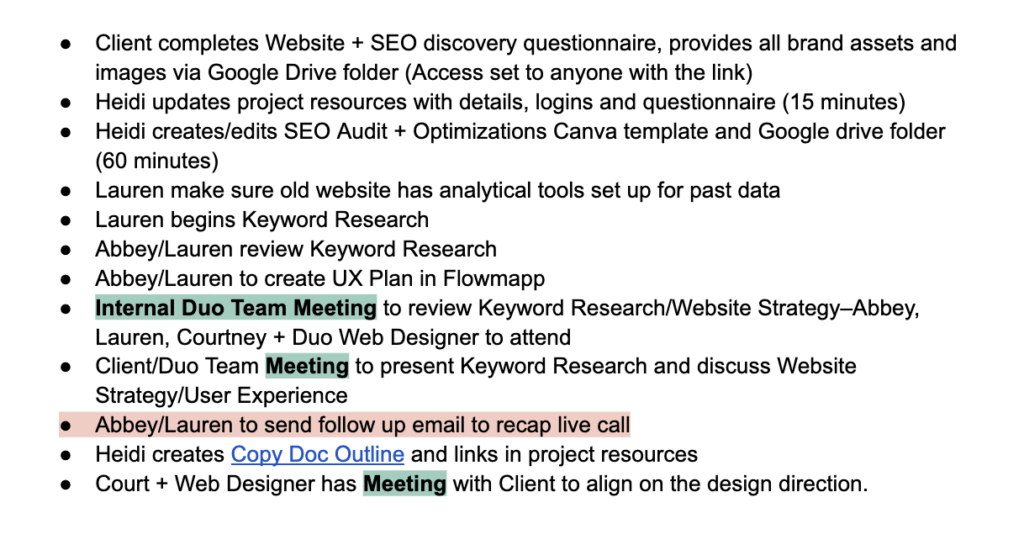
Our entire team reviews these documents to make sure the process is seamless and nothing is forgotten.
Step #3: Translate the SOP into actionable tasks.
This is where you assign ownership among your team or contractors.
This is when we move things from SOP to Asana. Your project management system is now how you will make sure these deadlines are met.
It’s where the tasks are allocated. We build these templates in Asana for each package so we can easily duplicate across clients and refine.
- Who is responsible?
- Who approves?
- Who reviews?
Step #4: Draft email templates
Email templates are serious life savers!
And no, they don’t need to be boring, and you don’t need to worry about them feeling too impersonal. Ours are packed with personality!
They also allow our team to speak with a single voice regardless of who sends the email.
We’d rather reduce decision fatigue by focusing on the email’s importance and then spend our energy and brainpower revising it for any personal edits.
Step #5: Build an Internal “How To” Library
Your how-to library is exactly what it sounds like: how to do everything within your business.
- How to update a contract
- How to invoice
- How to publish a podcast
- How to optimize a blog
- How to onboard a client
- How to run a launch week
Tools to help simplify this process:
- Google Docs
- ClickUp / Asana
- Notion
- Loom + AI summary tools – record once, embed into SOP
- Scribe or Tango – automatically creates step-by-step guides from screen recordings. If you’re already doing the task, just hit record and let the tool build the doc for you.
Do I Need to Know How to Write an SOP If I Don’t Have a Team?
You might be saying… Well, I don’t have a team. And this doesn’t apply to me.
Even if you’re solo, SOPs prepare you for growth.
And they save you from re-deciding things every week. We used SOPs and email templates even when it was just us.
What Will Your First SOP Be?
Now that you know how to write an SOP, you can start chipping away at them. You don’t have to spend an entire business day (well, maybe a CEO day!) writing SOPs. When you do a task, write down the steps or record yourself doing it and save it in a folder.
And if you need a starting point, get our free SOP template right here!
Don’t overcomplicate it and have fun with it!
FAQs About How to Write an SOP
An SOP should be detailed enough that someone unfamiliar with the task can complete it successfully without additional guidance, but not so complex that it becomes difficult to follow. Clarity and usability should always come first.
ChatGPT can help write your SOP, but it shouldn’t be the only step in the process. ChatGPT is great for creating a first draft or turning messy notes or voice transcripts into clear instructions. However, it still needs your input to be effective. SOPs are only valuable when they reflect your actual workflows, tools, and standards.
There is no ideal length. An SOP should be as long as necessary to clearly explain the process, but as concise as possible to keep it easy to follow.
Let’s Chat About SOPs!
Apple Podcasts | Spotify
If you loved today’s episode of The Duo On Air Podcast, we’d love for you to leave a review on your favorite platform and hit subscribe for those new episodes dropping every Monday — it helps more small business owners find us (and let’s be honest, that’s good SEO ).
More From The Duo
Sign Up for Tuesday Confetti Drop Newsletter
Abbey Oslin and Courtney Petersen are Minnesota-based marketing experts with over 20+ years of combined experience working with big brands. They are educators and co-founders of Duo Collective; a boutique organic marketing agency specializing in SEO, branding, and custom websites for women-led small businesses and creative entrepreneurs.
Ready to grow your visibility and become unforgettable?
Learn more or work with our team here.
To inquire about being a guest on Duo On Air, please fill out this application form.



+ show Comments
- Hide Comments
add a comment