



Are you confused by all the fun new SEO acronyms that have been used lately? GEO, AIO, SEO… The fear-mongering is real. Our SEO on Tap students have been asking what all these new terms mean, so let’s break down these SEO trends and find out what they really mean. Consider this your early 2026 SEO update!
Google Algorithm Updates
There are two types of updates that Google does regularly throughout the year:
- Big Core Updates (big-picture reassessments)
- Smaller ongoing updates (happening constantly in the background)
The goal of these updates is to make search results more relevant to queries.
What is a Core Algorithm Update?
A Core Algorithm Update is when Google takes a step back and re-evaluates which content best deserves to rank based on quality, relevance, and how well it serves searchers. It’s a reshuffle based on what Google thinks is most helpful right now. They happen 3-4 times throughout the year.
Common Misconception: Core updates are penalties.
Google does not penalize sites for breaking rules. Instead, they re-evaluate content relative to other content. If rankings shift, it’s because another page answered the question better or aligned more closely with what searchers want right now.
In other words… Google is refining how it understands good content—not looking for reasons to punish you.
How to prepare for Core Algorithm Updates?
Keep doing what you always do…
- Create good quality content that people actually want to read.
- Build authority and trust.
- Keep your content fresh.
It’s not about “preparing” for an update… It’s about maintaining quality over time.
Opting Out of AI-Generated Overviews
Google announced that it is exploring ways for sites to opt out of Google using their content for its AI-generative search features, such as AI Mode and AI Overviews.
This would mean telling Google… “You can still crawl my site, but don’t use my content to generate AI summaries.”
So what does this mean?
- You may lose visibility in AI-generated answers.
- You’re choosing classic blue-link visibility only.
Here’s why some businesses are asking for this:
1. They are seeing traffic loss: Users get answers without clicking
2. Content ownership: “We created this—why is it being repackaged?” We have less ownership over how our content is being portrayed in AI overviews.
3. Brand dilution: AI summaries remove tone, nuance, and positioning. You can’t articulate your opinion or voice in a single sentence.
4. Loss of Ad Revenue: Especially for content-heavy publishers (media companies, bloggers, publishers, educational websites) Content-heavy sites like media companies and bloggers make money when people click through and view ads on their pages, but AI Overviews often answer the question directly in Google, eliminating that click. When the click disappears, so does the ad revenue—even if their content helped inform the answer.
Finally, you’re hearing a lot of noise from the UK because their privacy and data laws are stricter, so AI using publisher content hits different there. That pressure is a big reason Google is even talking about opt-outs in the first place.
What’s Duo’s stance?
Right now… we wouldn’t be opting out of this. The visibility still feels powerful, even if it shows fewer clicks.
Search is Volatile Right Now… What Does This Mean?
Search volatility just means rankings are shifting more than usual. You probably wouldn’t notice this at all if you didn’t have a ranking tool tracking your keywords or popping into Google Search Console daily.
Some pages go up, some go down, sometimes day to day. It doesn’t mean something is broken; it usually signals that Google is actively testing and recalibrating how results are displayed.
Use this tracker to see how volatile search is in general and in your specific industry.
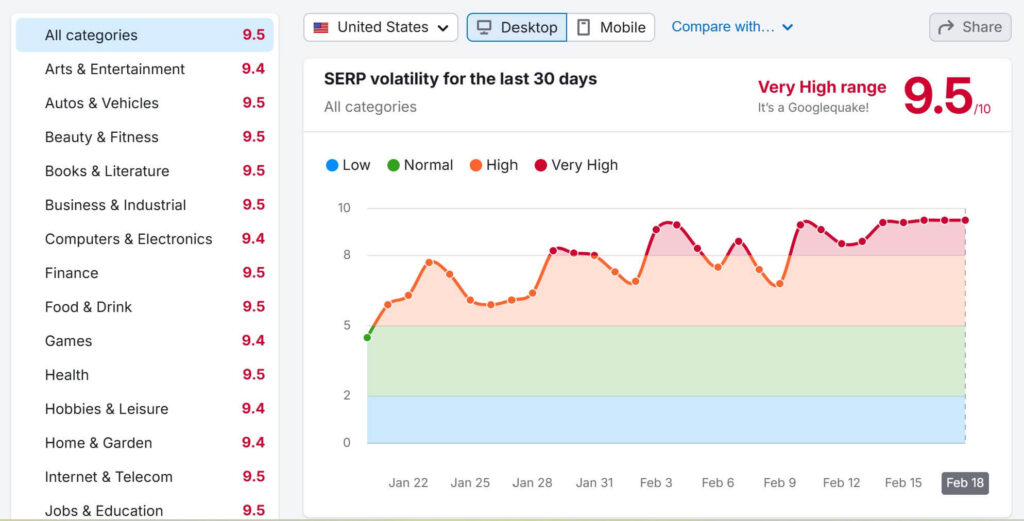
When volatility is high, it’s a sign that Google is in adjustment mode… so don’t freak out. Keep maintaining.
Ads are Inside ChatGPT
OpenAI has announced that it will begin testing advertising inside ChatGPT, specifically for users on the free plan and the new Go tier. These ads won’t be part of the AI answer itself; they’ll show up separately below the chatbot’s response.
What to know:
- The ads will be clearly labeled and separated from the AI’s answer.
- They’re planning to start testing in the U.S. first.
- Paid tiers like Plus, Pro, Business, and Enterprise will remain ad‑free.
- Users under 18 or conversations about sensitive topics (health, politics, etc.) won’t show ads.
Right now, ads are not yet live for everyone — this is a testing phase.
A few additional SEO trends we’ve noticed…
1. Google is doubling down on helpfulness over volume. This means you need to be revisiting old content and giving it a refresh. We’re seeing continued de-prioritization of thin content, mass-produced blog posts, and “creating content for content’s sake.”
2. Authority is becoming more brand-driven. Google and AI tools are relying more on recognizable brands, consistent c, and topical authority. In other words… It’s not just keywords—but who is saying it.
3. Local search is still living in the traditional search world. AI hasn’t quite figured this out yet.
So, a quick summary of what all this means…
Keep doing what you are doing!
Focus on:
- Quality and relevance.
- Your audience and what they want to see online.
- Growing your authority and trust.
- Defining your own unique voice in this space.
These are the foundations that see long-term growth online, whether it’s Google, ChatGPT, or some other online platform.
Want to stay up to date with all these SEO trends and updates? Join SEO Squeeze, a weekly newsletter with SEO tips you can do in 10 minutes or less.
And if you want even more SEO support, join SEO on Tap, our DIY course that makes SEO feel easy and doable.
FAQs About SEO Trends
Yes, but the strategy has evolved. While some searches end without a click, SEO now plays a role in brand visibility, building trust, and capturing high-intent traffic. Businesses that focus on depth, authority, and search intent are still seeing strong SEO results.
Absolutely, but again, the strategy is changing. Keyword research is less about chasing single keywords and more about understanding topics, search intent, and how people actually ask questions.
SEO isn’t set-it-and-forget-it. While core principles stay consistent, strategies should be reviewed quarterly to adapt to algorithm updates, performance data, and shifts in search behavior.
Prefer to Listen?
Apple Podcasts | Spotify
If you loved today’s episode of The Duo On Air Podcast, we’d love for you to leave a review on your favorite platform and hit subscribe for those new episodes dropping every Monday — it helps more small business owners find us (and let’s be honest, that’s good SEO ).
More From The Duo
Sign Up for Tuesday Confetti Drop Newsletter
Abbey Oslin and Courtney Petersen are Minnesota-based marketing experts with over 20+ years of combined experience working with big brands. They are educators and co-founders of Duo Collective; a boutique organic marketing agency specializing in SEO, branding, and custom websites for women-led small businesses and creative entrepreneurs.
Ready to grow your visibility and become unforgettable?
Learn more or work with our team here.
To inquire about being a guest on Duo On Air, please fill out this application form.


+ show Comments
- Hide Comments
add a comment